
Start an Estill Property Search
Start with whatever fact is firmest. An address fits the Estill PVA qPublic search. A name works in both qPublic and the County Clerk's eCCLIX index. A full parcel number links several records together. Sometimes called an APN, it joins assessment, map, tax, and deed records. Estill numbers keep their punctuation and leading zeroes. Copy one exactly as printed before trying another format.
Treat any result as a lead rather than a title opinion. The PVA card describes a tax parcel and an assessment snapshot. The newest recorded deed carries the conveyance history. A map polygon adds location context but never establishes a surveyed line.
- Search the PVA by address, owner, or exact APN.
- Save the parcel ID, tax owner, value year, and deed reference.
- Check the owner or book/page in the Clerk's land index.
- Ask the Sheriff for the current bill and the Clerk for delinquent tax.
- Request certified records or an office search when online evidence is incomplete.
Estill Property Record Custodians
Estill County property records sit with four custodians. The County Clerk records land instruments. The Property Valuation Administrator maintains parcel, assessment, mapping, and exemption data. The Sheriff collects current property tax, while the Circuit Court Clerk holds local files on foreclosure, boundaries, judgments, and probate litigation.
Estill County PVA
Courthouse Room 104, 130 Main Street
Irvine, KY 40336
606-723-4569
Estill PVA Parcel Clues
The Estill PVA lists real and personal property valuation among its local services. It also handles mapping, homestead and disability exemptions, and agricultural exemptions. Its qPublic link is the first route to an APN and a tax-owner snapshot. The portal's exact buttons, filters, and parcel-card tabs vary by county. Explore the live site directly. View the official Estill PVA page for the office's own list of services.
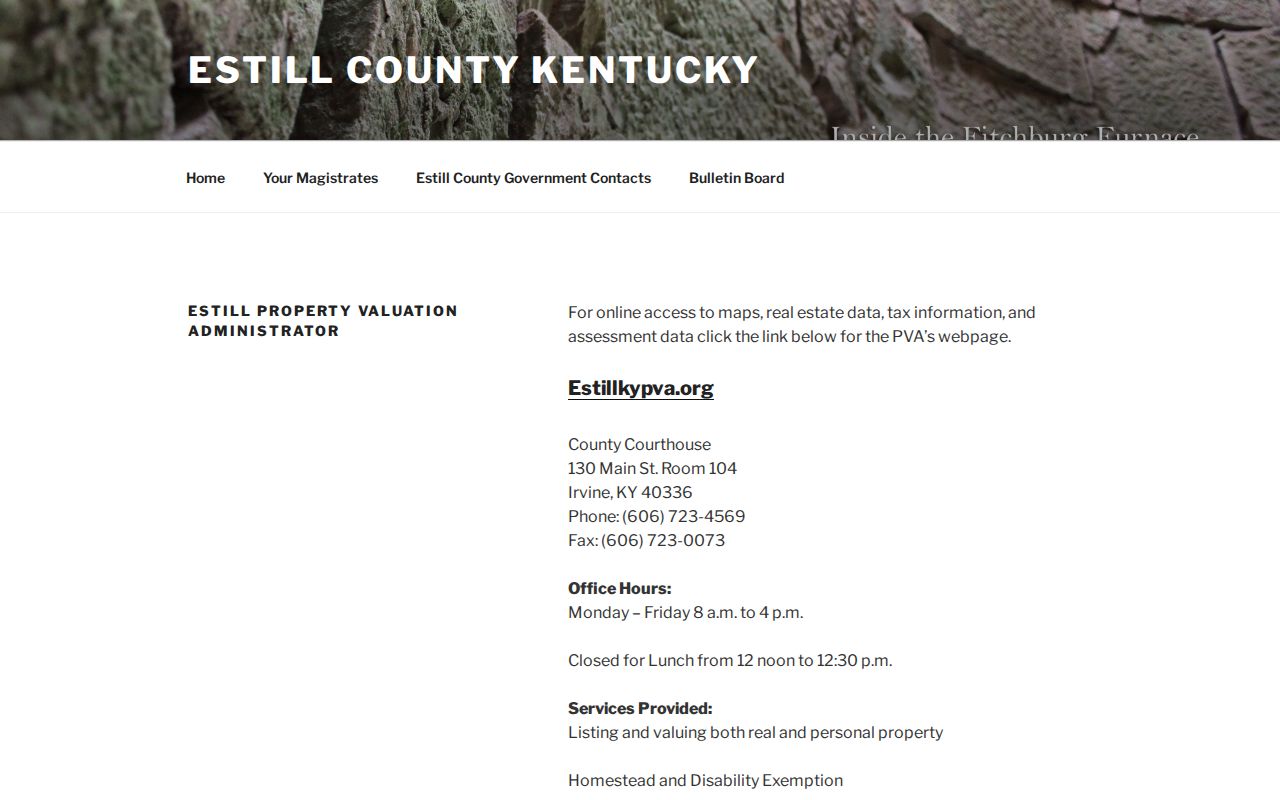
The capture confirms the office route. It is not a captured parcel result.
Estill Deed Index Milestones
The Clerk's eCCLIX page marks the line between an index lead and a document image. Deeds and mortgages are indexed back to 1966. Scans run back that far too. Most instrument images are online from January 2004 forward. Older books may require the courthouse, microfilm, KDLA, or FamilySearch. That gap explains why a name search can return a reference. The reference may come with no viewable image at all.
| Access route | What it offers | Limit |
|---|---|---|
| Clerk office | Public indices and records | A visit or request may be needed |
| Free eCCLIX | Online index leads | Five searches daily, weekdays 9 a.m. to 7 p.m. |
| Paid eCCLIX | Expanded data and images | Account and image fees may apply |
Review the official eCCLIX access page pictured here.
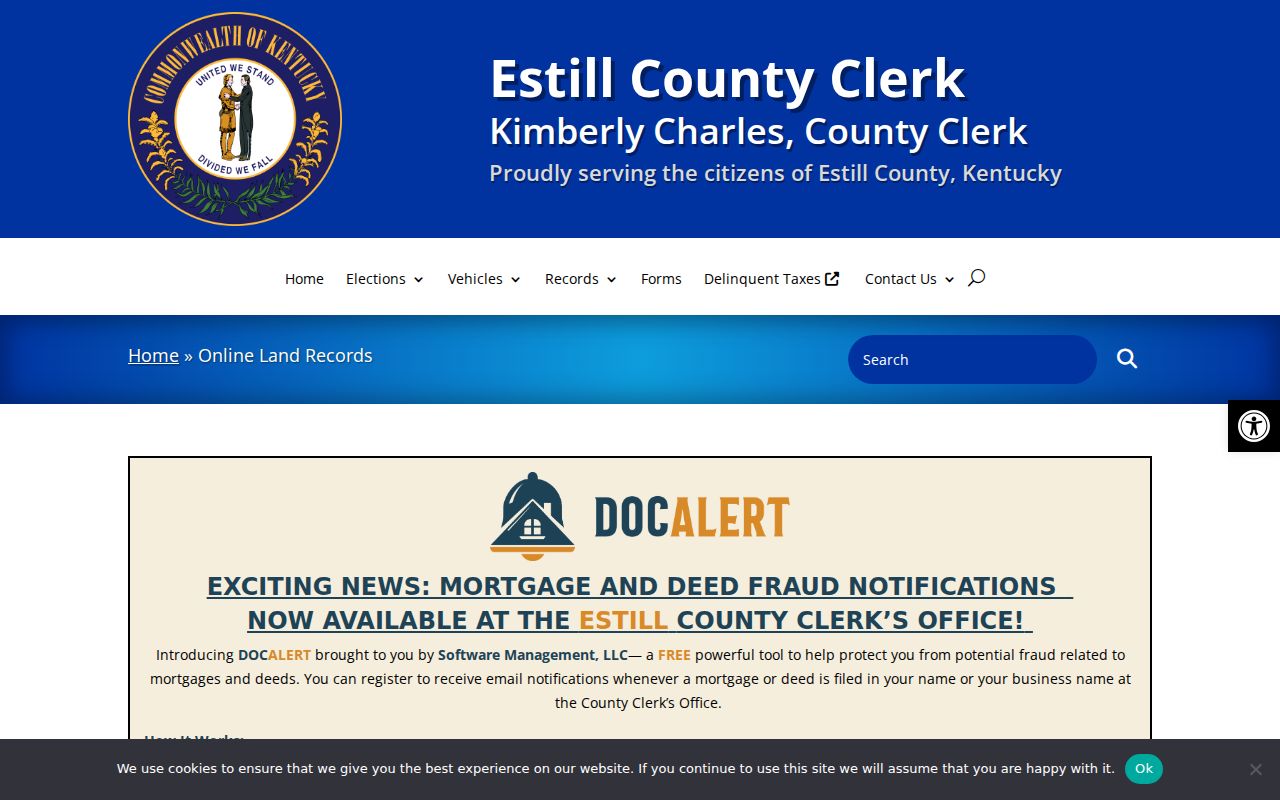
The capture supplies account rules; definitive index confirmation remains with the Clerk.
Estill Property Records by Type
Each record type answers a narrow question. Deeds document transfers. Assessments describe the parcel for tax purposes, and tax bills show collection status. Plats and surveys carry boundary evidence, while court files may explain a forced sale, partition, judgment, or disputed claim.
| Record | What it documents | Keeper | Access |
|---|---|---|---|
| Deed | Parties, date, legal description, book/page | County Clerk | Office or eCCLIX |
| Mortgage or lien | Recorded claim, assignment, or release | County Clerk | Office or eCCLIX |
| Assessment | Tax owner, parcel, value, exemptions | PVA | qPublic or office |
| Tax bill | Current charge and payment status | Sheriff | Office, phone, or request |
| Court file | Foreclosure, partition, boundary, judgment | Circuit Court Clerk | Online lead plus local file |
Start with the Estill County property search whenever you have only a name or an address to go on. Note the custodian, the date, and the record number for each document you pull.
Why Estill Tax Owners Lag
Kentucky real property is assessed as of January 1, and the local PVA says ownership for tax purposes is set then too. A deed recorded later can name a new grantee while that year's bill still carries the former owner. The PVA tries to mail the bill to a buyer with a care-of notation based on the deed, but a tax-owner field is not proof of the latest transfer.
Resolve an apparent conflict by saving three facts: the newest deed and recording date, the PVA owner as of January 1, and the bill's mailing label. Each can be accurate for its own date.
Read an Estill Tax Statement
An official 2022 Estill statement offers a useful field checklist without replacing a current bill. It labels map number, location, legal description, farm acreage, deed reference, exemption, and owner. Its APN is 053-00-00-030.00. Keep every zero, hyphen, decimal, and suffix when carrying that key into another search.
- Parcel or APN
- The local key linking assessment and map records.
- Book/page
- The recorded deed location.
- Assessed value
- A tax assessment, not a sale appraisal.
- Plat
- A recorded plan of lots, roads, or subdivision layout.
The Sheriff handles the current property-tax bill. The Treasurer receives and pays county funds but sends parcel-tax questions to the Sheriff.
Estill Parcel Maps Have Limits
The PVA map helps place a parcel. It can also identify an APN. And it lets you compare nearby roads or tracts. Dates matter here. One reproduced PVA aerial uses Spring 2019 imagery in a view dated October 18, 2022, so it serves as historical evidence rather than a current layer. The official KYTC map adds routes, rivers, railroad, and city context.
For an exact line, obtain the deed, the referenced plat, and the survey. One official utility filing's survey lists APNs, owners, title source, easements, and a datum. It also warns that its map is not intended for land transfer.
Estill Court Property Cross-Checks
Some events outrun a parcel card or deed index. Foreclosure, partition, probate litigation, boundary disputes, and judgment liens belong with the Estill Circuit Court Clerk. KYeCourts can supply a case lead, but public online information is not the official court record. Save the case number, parties, court, filing date, and disposition. When the outcome matters, obtain the local file. View the Estill court information source for direct details.
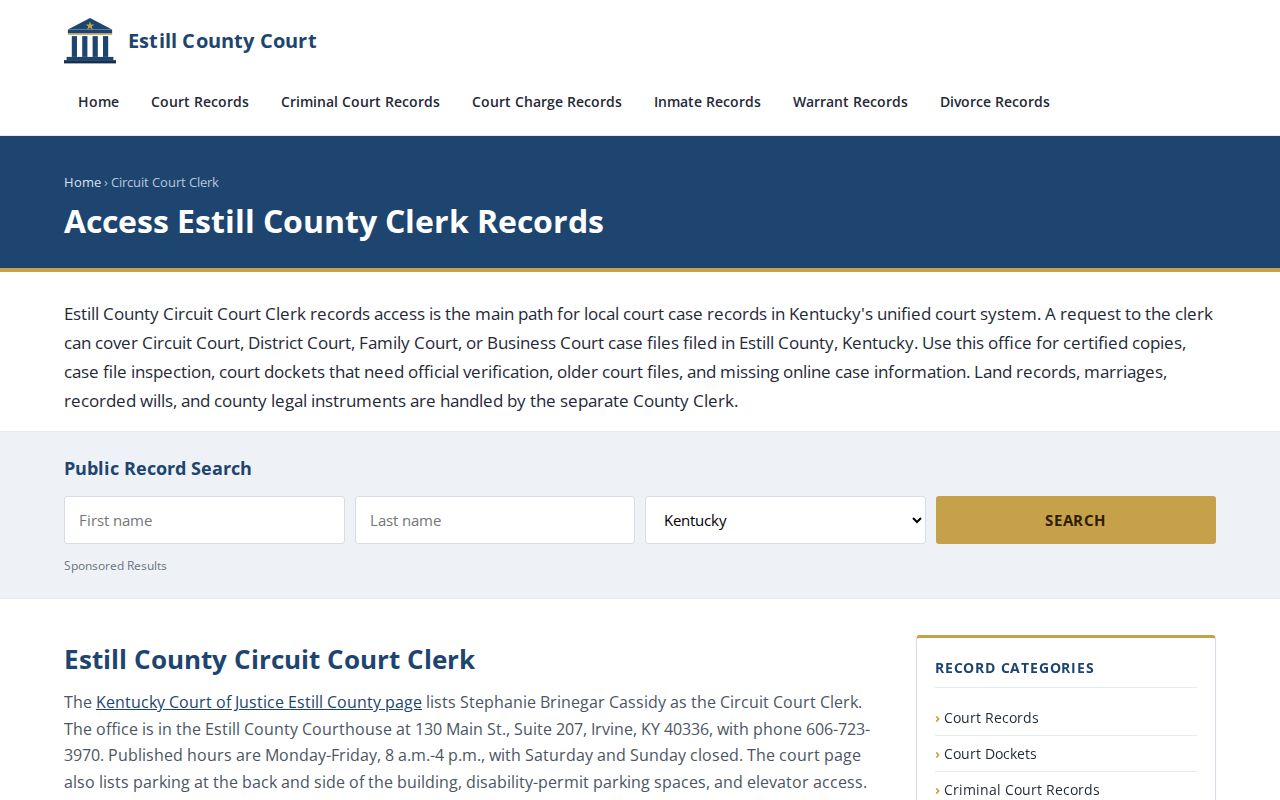
The image marks the court route, not proof of a claim against any parcel.
Estill Records Before 1966
Estill County dates to 1808, and archive inventories show deeds from that founding year onward. Tax books, surveys, wills, and court records round out the early holdings. A courthouse disaster struck in 1864. Because official history does not itemize which land series were lost, treat the event as a caution rather than proof that any one chain is broken.
Once eCCLIX hits its online limit, other tools carry the search. Clerk deed books and microfilm, KDLA inventories, FamilySearch, and the Estill Historical and Genealogical Society all hold material. The local library's NewsBank and HeritageHub access helps too. A dated transfer notice, an obituary, or an old place name can sharpen an index query considerably.
Estill Deed Fraud Alerts
The County Clerk links to DOC ALERT, a name-monitoring service for deed and mortgage filings. An alert is only a prompt to pull the filing itself. It is not a finding of fraud. It is not proof of title, and no substitute for the recorded instrument. Open the official Estill DOC ALERT signup shown here.
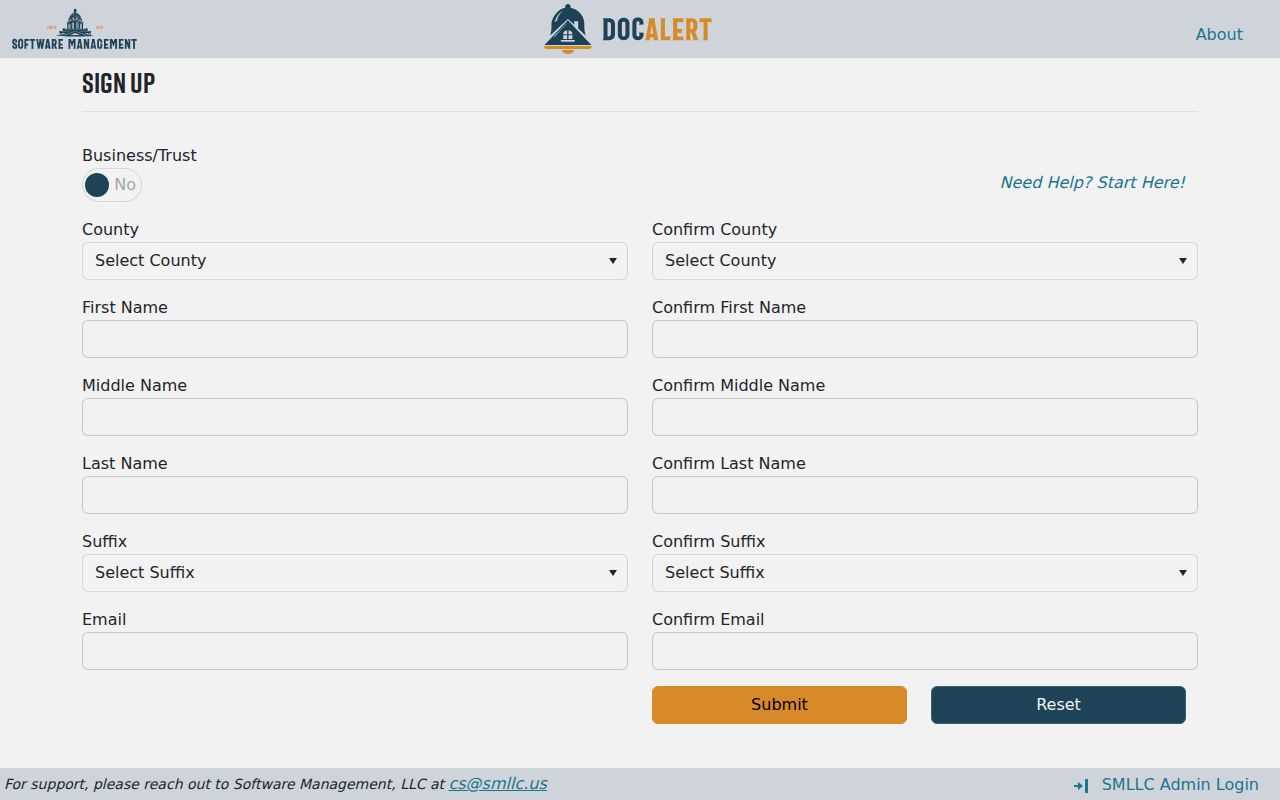
The signup page shows only the notification route.
Irvine and Ravenna Geography
Irvine and Ravenna are Estill County's two incorporated cities. Deeds, assessments, and tax records stay county-held. Zoning, permits, and boundary material may sit with a city office. A postal city is not an incorporated boundary. An Irvine mailing label can fall outside Irvine. A Ravenna description may need a city-line check before you rely on it. Compare the PVA map against city material, KYTC context, and USPS data. Annexation can shift zoning or service jurisdiction without rewriting an older legal description.
Estill Open Records Requests
When a record is not online, the Kentucky Open Records Act supplies the route. KRS 61.872 calls for a written, specific request to the custodian. KRS 61.880 governs the response and the basis for any denial. KRS 61.874 separates inspection from copies and permits actual reproduction costs.
Name the parcel, address, owner, book and page, record series, and date span. State whether inspection or copies are sought. Save the request, the response, the quote, the format, and the deadline. A narrow request is far easier to answer. That helps the Clerk, PVA, Sheriff, court clerk, or city clerk.
Limits of Estill Property Records
Estill County property records can identify tax parcels, recorded parties, and assessment fields. They also cover liens of record, deed references, plats, and court matters. But they cannot show every unrecorded claim or guarantee a boundary. They cannot prove that an assessment equals sale value. Nothing in them replaces a certified document. Public access also does not justify bulk harvesting or misuse of personal details.
Lawful use. Use Estill County property records for due diligence, boundary research, estate work, and civic review. A records search is not a title search or survey, and owner data must never be used to stalk, harass, or harm anyone.
Estill Delinquent Tax Records
Current property tax and delinquent tax do not share a custodian in Estill County. The Sheriff collects the current bill. Once the statutory collection period closes, unpaid bills move to the County Clerk. They become certificates of delinquency. Kentucky Revenue places that transfer after April 15. The DTax list offers a status lead, but its availability changes. Confirm any county certificate with the Clerk directly.
A 2024 Estill public notice illustrates the annual rhythm of discount, face amount, January penalty, later penalty, and transfer. Dated evidence, though, is not a schedule for a later year. Confirm present deadlines and payment instructions with the Sheriff. If a bill has transferred, ask the Clerk for the certificate number, principal, fees, interest, notices, and assignments. Ask about sale status too.
A certificate purchaser holds a tax claim. That purchase alone does not confer fee-simple ownership. Court and redemption steps can matter, and a parcel may carry other recorded interests. Keep the bill year, transfer date, certificate status, and deed history separate in your notes. Check the official DTax county list shown below.
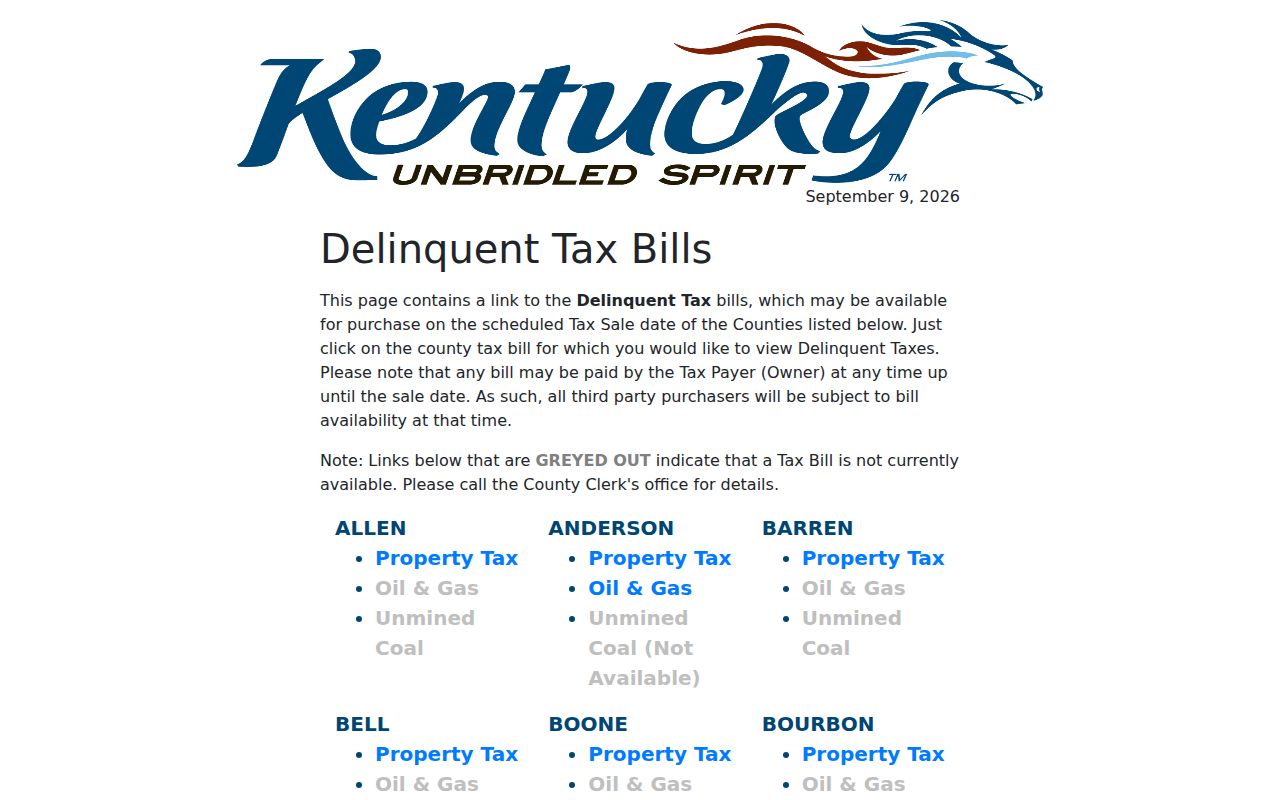
The list is an access point, not a status record.
Estill Search Evidence Checklist
A strong Estill County property-record file preserves more than a result name. Save the source URL and the access date. Capture the search mode, the exact query, and the visible filters. Record the result count and the selected record. Copy the APN exactly. Keep the assessment year, map date, owner field, and mailing address. Hold onto the deed book and page, instrument date, document type, and legal-description text. Note any account, fee, access block, or missing image along the way.
Rural properties need extra care. Retain both the source address and a normalized form. Add the postal city and the incorporated place if confirmed. Include any road or route variant, a nearby creek or landmark, and the subdivision name. Do not force those labels to agree. A mailing city can differ from city jurisdiction. An old deed may use a road or natural feature a modern card no longer shows.
Confidence should follow the question asked. A PVA card is strong for its dated assessment snapshot. A recorded deed is strong for the conveyance it contains. A court order may explain a transfer or claim. A plat or survey beats a tax map for line work. Yet its scope and disclaimer still control. When sources conflict, report both dates and ask the proper custodian to resolve the mismatch.
Every recorded instrument carries a role label worth learning. A grantor gives up an interest. A grantee takes it. Not everything that shapes a land search is a deed, though. Mortgages, assignments, releases, powers of attorney, mechanic's liens, tax liens, wills, and name-change filings can all matter. Some of these shape ownership in surprising ways. Search by document type and date range instead of assuming every land event sits under a single category. The index may group them differently than you expect. When the index hands you an instrument number or a book and page citation, keep it. Keep it beside the party names and the recording date.
Estate work often crosses from probate into deeds. The County Clerk reports wills indexed and scanned back to 1797. A contested estate or partition may also generate a Circuit Court file. The will by itself seldom shows the final parcel transfer. Follow the fiduciary deed, the court order, or the later conveyance that actually lands in the record. That instrument is what settles title. For older probate and court material, KDLA or courthouse access may be required.
Place names can rescue a weak search. Estill deeds and transfer notices lean on subdivision names, railroad-town lots, additions, creeks, highways, and acreage tracts. Ravenna Realty Company lot language echoes the city's railroad-rooted growth. Irvine records may hold city, road, and annexation clues. Treat a newspaper notice as a search string only. Confirm the full legal description, exceptions, easements, and parties in the recorded instrument itself.
Keep convenience separate from authority. An online index helps you locate a record. A screenshot only shows what appeared on a given day. A certified copy comes from the custodian. A title opinion requires qualified review. A boundary conclusion rests on the recorded evidence plus a licensed surveyor. The strongest Estill County property records search keeps those roles distinct from first query to final citation.