
Read Estill Tax Record Fields
Assessment and collection sit in separate files. The Property Valuation Administrator, or PVA, identifies and values each parcel. The Sheriff collects the current bill. A bill that goes unpaid long enough transfers to the County Clerk. It arrives there as a certificate of delinquency. The Treasurer receives and disburses county funds but sends parcel-tax questions back to the Sheriff.
| Field | What It Shows | Where |
|---|---|---|
| Assessed value | Value placed on the parcel for tax administration | Estill PVA |
| Land and improvements | Components supporting the total value | Estill PVA card |
| Exemption | Qualified reduction shown for that assessment year | Estill PVA |
| Bill and payment status | Amount charged and whether payment is current | Estill Sheriff |
| Delinquency certificate | Unpaid obligation after statutory transfer | County Clerk and DTax |
An assessed value is not the bill. It is not automatically a sale price either. State and local district rates get applied to the relevant taxable value. Exemptions can shrink that base. For a fuller picture, the Estill County property value explanation compares value types. It does not convert them into a tax calculation.
Keep the year beside every field you copy. A sale, new construction, a parcel split, an agricultural classification, or a changed exemption can make two years look nothing alike. That can happen without any clerical mistake. District lines matter too. A statewide rate alone cannot reproduce a full Estill bill. County, school, city, and special-district charges may all stack on top.
Estill's Three Tax Offices
The Estill PVA sits in Courthouse Room 104 at 130 Main Street, Irvine, and answers the phone at 606-723-4569. Its listed services cover real-property valuation, mapping, homestead and disability relief, and agricultural classification. Published hours run Monday through Friday, 8 a.m. to 4 p.m., with a noon to 12:30 lunch closing.
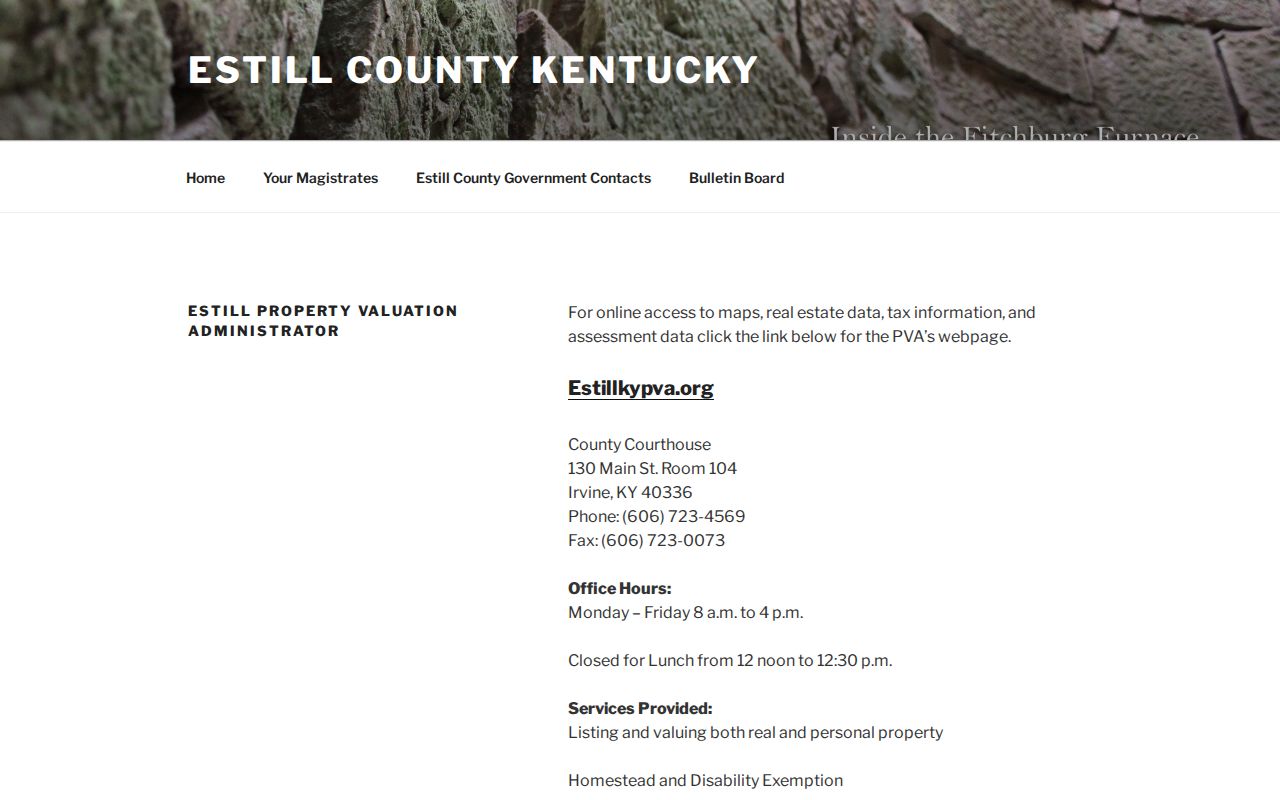
The PVA is the local assessment contact. Bill collection belongs to the Sheriff, not the PVA office.
Find the Sheriff at 119 Broadway, Suite 1, Irvine, or call 606-723-2323. Published non-tax-season hours are Monday, Tuesday, Thursday, and Friday from 8:30 a.m. to 4 p.m. Wednesday ends at noon. An extra Thursday drive-through window runs during tax season. Confirm hours before making the trip. The county offers no online current-bill search by owner, address, bill number, or APN. Call or submit a bill-specific request instead.
January 1 Sets Estill Ownership
Kentucky assesses real estate as of January 1. Estill's PVA also states that ownership for tax purposes is fixed on that date. A buyer whose deed records later in the year may therefore see the former owner on that year's tax bill. The PVA tries to mail the bill using a “Care of new owner” notation based on the recorded deed.
Tax name versus deed name. A January 1 tax owner is not automatic proof of the latest recorded ownership after that date.
Put the assessment year next to the Clerk's newest recording date. If the bill never arrived or payment status is the question, ask the Sheriff. If the recorded transfer itself needs confirming, the Clerk holds that answer.
Retrieve an Estill Tax Bill
The official online route runs through the PVA's qPublic redirect. Treat the generic qPublic controls with caution, since the Estill application does not always load. When it fails, the office and phone routes remain the dependable fallback.
- Find the parcel through the PVA using its address, owner, or exact APN when available.
- Copy the APN, assessment year, owner label, value, exemption, and district.
- Give the Sheriff that APN and year to request the current bill or payment status.
- For an unpaid transferred bill, check the Clerk process and DTax status.
- Assessed value
- The PVA's value for tax administration before applicable relief.
- Tax rate or levy
- The rate applied by a state or local taxing authority.
- Homestead exemption
- A reduction available to qualifying older or totally disabled owners who apply.
- Tax lien
- A legal claim tied to unpaid property tax.
Fields on an Estill Statement
An official 2022 sample statement shows what a real bill contains: bill number, district, location, APN, legal description, deed reference, owner, farm acreage, and exemption. Its APN appears as 053-00-00-030.00. Copy the punctuation and leading zeroes exactly.
That sample documents 2022, not the current year. Use it to learn how to transcribe a result. Check the named owner against the January 1 rule, and match the deed reference to the Clerk's latest recorded conveyance.
Estill Discounts and Penalties
The 2024 Estill notice set bills due October 1, allowed a 2 percent discount through November 1, charged face amount from November 2 through December 31, added a 5 percent penalty in January, and applied a 21 percent penalty from February 1 through April 15. Unpaid bills transferred to the Clerk after April 15.
Those dates describe the 2024 cycle only. Check the current annual notice and the Sheriff's instructions. The same notice asked mail payers to include the top portion or bill number, plus a self-addressed stamped envelope for a receipt.
Kentucky publishes annual property-tax rate books and spreadsheets. Do not estimate a parcel total from the state rate alone, because Estill's district rates may not appear separately there. Request the bill's full district and rate breakdown when checking the arithmetic.
Estill Homestead Tax Relief
Kentucky's homestead exemption generally requires an owner to be at least 65. Total disability also qualifies. Either way, the owner must supply proof and file an application with the local PVA. The official amount for 2025 and 2026 is $49,100. Earlier years carry different figures, so always pair an exemption with its assessment year.
Form 62A023 is the state application route. Government, religious, educational, charitable, cemetery, and other constitutionally exempt property follow separate rules. Never infer an exemption from an owner's age, a property's use, or a missing charge. Confirm status with the Estill PVA.
Delinquent Estill Tax Certificates
Estill County tax certificates begin with the April 15 transfer. After that date, the County Clerk runs the certificate-of-delinquency process. Kentucky Revenue spells out the added fees, interest, notices, publication, and the later certificate-sale window. A certificate is a tax claim. It is not a deed, not immediate possession, and not proof that title has moved. For delinquency work in Estill County, use one online status route. That route is the Kentucky DTax list. Its availability and sale labels can shift. Confirm the parcel, tax year, owner of record, principal, charges, sale status, and any release directly with the Clerk before relying on an entry.
Tax distress generates several property records on different timetables. Keep the original tax bill, transfer date, certificate number, notices, publication date, and sale status together. Track assignments, payments, and any release alongside them. A foreclosure case, if one follows, belongs to the Circuit Court Clerk. The recorded lien or later deed stays with the County Clerk's deed records.
Kentucky Values Estill Parcels
Kentucky defines fair cash value as the estimated price in a fair voluntary sale. Revenue guidance recognizes the sales comparison, cost, and income approaches. Every parcel must be physically inspected at least once each four years. New construction is added annually. Farmland can qualify for a special agricultural value instead. State guidance sets taxable real property at 100 percent of fair cash value. That standard does not force every Estill County parcel value to equal its latest sale price. Parcel size, condition, transfer type, construction, exemption, and classification can all explain a gap between the tax roll and a deed record. The date of each figure can also explain it.
Challenge an Estill Assessment
Kentucky's annual property-tax calendar opens with inspection of the assessment roll. A conference with the PVA follows. Still disagreeing? File with the county clerk by the next workday after the inspection period closes. The local board of assessment appeals will review the case. A further Kentucky Board of Tax Appeals filing is due within 30 days of the local board decision. Use the current year's calendar, because dates move.
Bring evidence. The parcel card, photographs, correct acreage and characteristics, recent comparable sales all help. An appraisal, if available, helps too. Records showing a classification or exemption error also help. Start with the PVA, not the Sheriff. The PVA sets the assessment; the Sheriff only collects the tax bill.
Ask which evidence the PVA relied on. Compare like property to like property. A nominal deed consideration, family transfer, partial-interest deed, or sale of different acreage may not be a sound market comparison. Keep copies of everything. That means the conference request, exhibits, the PVA response, the local-board filing, the decision, and any later appeal.
Watch the annual window. Complete the PVA conference and file by the current calendar deadline; a tax-payment question does not preserve an assessment appeal.
Note: Keep the assessment year, bill year, payment date, and custodian beside each figure. Those dates keep one year's value from being matched to another year's tax status.