
Estill Current-Owner Record Card
Start with the PVA card for any known parcel. Its owner label sits beside the parcel number, property address, mailing address, assessment year, values, exemption, map reference, and sale history. The live Estill qPublic card carries the same details once the application loads. Field labels there can shift, so confirm them directly on the screen.
| Owner label | The party named on the PVA's dated assessment snapshot |
|---|---|
| Parcel or APN | The county identifier that ties the card to the land |
| Mailing address | Where assessment or tax correspondence is sent |
| Property address | The situs, meaning the parcel's physical location label |
| Deed reference | A book/page or instrument lead for Clerk verification |
| Record dates | The assessment and recording dates needed to resolve a mismatch |
The owner of record is the party a cited public record names. It is not necessarily the occupant. A mailing address often differs from the physical address, especially for an estate, farm, or entity that owns from afar. Never infer residence from the owner field.
A sound owner statement names its source and date. Each record answers a different question. “PVA owner on the assessment record checked” beats an unqualified claim about ownership today. “Latest recorded grantee through the Clerk” speaks to recording history, yet it should still preserve the search date and allow for a later correction or court order.
January 1 Freezes Estill Tax Names
Estill PVA fixes tax ownership on January 1. A purchase that records later leaves the former owner on that year's tax bill. The clerk may already hold the newer deed. This lag is normal. The PVA still tries to mail the bill with a “Care of new owner” notation drawn from the recorded instrument.
Read both dates. A tax-roll owner after a January 1 transfer may not be the latest recorded owner.
This timing is expected, not an error. Keep the assessment year, deed date, and recording date. The Sheriff handles missing-bill and payment questions; the Clerk answers questions about the newest grantee.
Estill PVA Snapshot Limits
The Estill PVA office works from Courthouse Room 104 at 130 Main Street in Irvine, telephone 606-723-4569. Its duties cover parcel identifiers, values, exemptions, mapping, agricultural classification, and the tax-owner date rule. Doors open weekdays from 8 a.m. to 4 p.m. A lunch closure runs noon to 12:30.
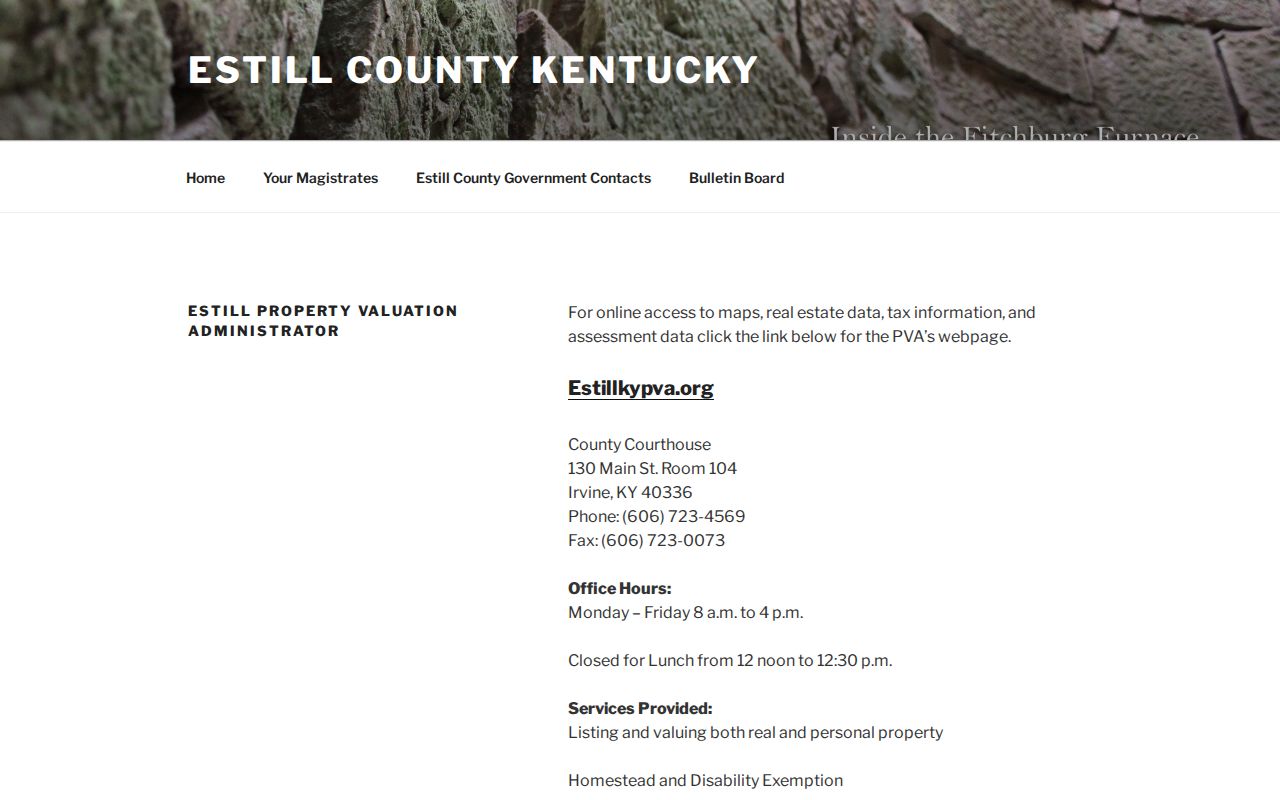
The office's own page backs the direct fallback whenever qPublic is down and a dated owner snapshot is needed. Calling or visiting works well. Ask for the current parcel card and the date through which ownership transfers have been posted. A written Kentucky Open Records Act request under KRS 61.872 can name the record series, APN, address, date span, and format wanted. The PVA snapshot is assessment evidence. It is not a stand-alone title opinion.
Confirm Estill's Owner of Record
Verification pairs the PVA snapshot with the latest deed. Anchor every search to the parcel and legal description rather than to everyone sharing a surname.
- Copy the current PVA owner label, exact APN, address, and assessment year.
- Search eCCLIX for that party as grantee and match the same land description.
- Inspect later correction, fiduciary, commissioner, or other conveyance instruments.
- Save the newest deed reference, grantee wording, and recording date.
- Owner of record
- The party named by the specific, dated public record.
- Vesting
- The deed language stating how the grantee receives the interest.
- Registered agent
- An entity's official service contact, not necessarily its owner.
The Clerk's records page indexes deeds back to 1966. Most online images start in January 2004, and office inspection is open when an image will not load. For a wider address-to-owner method, see the Estill County ownership route.
Match Estill Parcel Identity
An owner name never uniquely identifies land. Estill parcel numbers lean on punctuation and suffixes. Official examples like 053-00-00-030.00 and 053-00-00-008.01 show the pattern. Keep every zero, hyphen, period, and suffix intact on the first pass.
Match the APN to the deed's subdivision, lot, block, acreage, road, creek, or metes-and-bounds text. Addresses can mislead. A postal city and a municipal boundary often disagree. An Irvine mailing label can sit beyond the Irvine city line. A Ravenna reference may call for a map or plat check. Legal description and parcel identity beat the city label every time.
Estill Entity Owner Names
A deed can name an LLC, corporation, trust, or estate instead of a person. Search eCCLIX under the exact legal name and its punctuation variants. Kentucky's Secretary of State business search can confirm an entity name and its filed documents. It does not replace the recorded Estill deed.
A registered agent is the contact for formal service. The role shows no beneficial owner. A trust name may omit beneficiary details. An estate chain may need a will, probate order, or fiduciary deed.
Sparse results deserve former names, initials, spacing, abbreviations, and exact business suffixes. Require two land anchors, such as APN plus legal description. Group records only after those match. Kentucky UCC filings answer a separate debtor-name question about business collateral. They do not form a real-estate ownership index.
Estill Judicial Owner Changes
Foreclosures, probate fights, partitions, and judgment liens can all explain why the deed index and the PVA assessment roll disagree about who owns a parcel. A docket entry by itself proves nothing about title. Confirm the outcome before trusting either record.
Pull the case file from the Estill Circuit Court Clerk, whose office sits at 130 Main Street, Suite 207, in Irvine, at 606-723-3970. Match any commissioner deed, fiduciary deed, or sale confirmation that the County Clerk actually recorded. KYeCourts is a helpful public lookup, but it is not the certified file. Keep the case number, the parties, the disposition date, and the recording reference together.
Capture the Current Estill Result
A solid current-owner result should show its own trail. Record the custodian, the exact URL, the date and time you accessed it, your query, the owner-of-record label, the parcel number, the address, the assessment year, the deed citation, the legal-description match, and the recording date. If a portal blocks you, call it a gap. A blocked search never means no owner record exists.
Some situations demand more than notes. For a closing, a boundary dispute, an estate, or any matter with legal weight, order the certified record from its custodian and get qualified title advice. A screenshot shows what a public user saw on one day. It cannot stand in for a certified deed.
Contact an Estill Property Owner
For a good-faith property matter, the right contact route is the mailing address on the parcel record. Use the least data the situation requires. Public documents still hold private details.
Do not republish signatures, account data, full birth dates, protected addresses, or unrelated personal facts. A recorder's file may contain them, but that does not make them fair game. Kentucky's Safe at Home program gives eligible participants a substitute mailing address. Official guidance exempts real-estate holdings from substitution. That exemption never justifies hunting down a protected physical address somewhere else.
Lawful use only. Use public owner information for legitimate property research; never use it to stalk, harass, intimidate, or target a person.
Write down the date of both checks. A later deed or an assessment update can shift which record is the better current evidence of the owner of record.