
Which Estill Deeds Matter
The Estill County Clerk runs recording through its Legal Records Department. That office is the recording hub for the county. Its index reaches well past ordinary sale deeds. A thorough deed-record search may pull in a correction or an assignment. It may also surface a release, a power of attorney, a will, a tax lien, a mechanic's lien, a mortgage, or a name-change filing. Remember what the instrument type tells you. It describes the paper filed, not whether the transfer settled every possible title issue.
| Deed Type | What It Does | Common Use |
|---|---|---|
| Warranty deed | Conveys the stated interest with title promises | Arm's-length sale |
| Quitclaim deed | Conveys only the interest the grantor may hold | Family or title cleanup transfer |
| Correction deed | Corrects a prior recorded instrument | Name or description repair |
| Fiduciary or commissioner deed | Records a transfer made through an estate or court process | Probate, partition, or judicial sale |
| Mortgage or release | Creates or releases a secured claim | Loan and payoff history |
A deed transfers an interest. A mortgage or a lien burdens one instead. A release can clear that recorded claim. Search related filings under both parties and compare the same legal description across each one. That habit keeps a deed-only search from missing the paper trail around a transfer.
Treat each instrument on its own terms. A quitclaim is not automatically invalid, and a warranty deed does not erase every risk. Read the exact interest conveyed, the exceptions, the signatures, the acknowledgment, and the recording stamp. A correction can repair a faulty name or description. Estate and judicial transfers may also list roles. They may not use the familiar seller and buyer labels.
Estill Clerk Index Access
Remote searching runs through the County Clerk's eCCLIX page. Deeds and mortgages are indexed and scanned back to 1966, according to the Clerk. Most instrument images are different. They are viewable online only from January 2004 forward. So an index hit can appear with no image attached for home viewing.
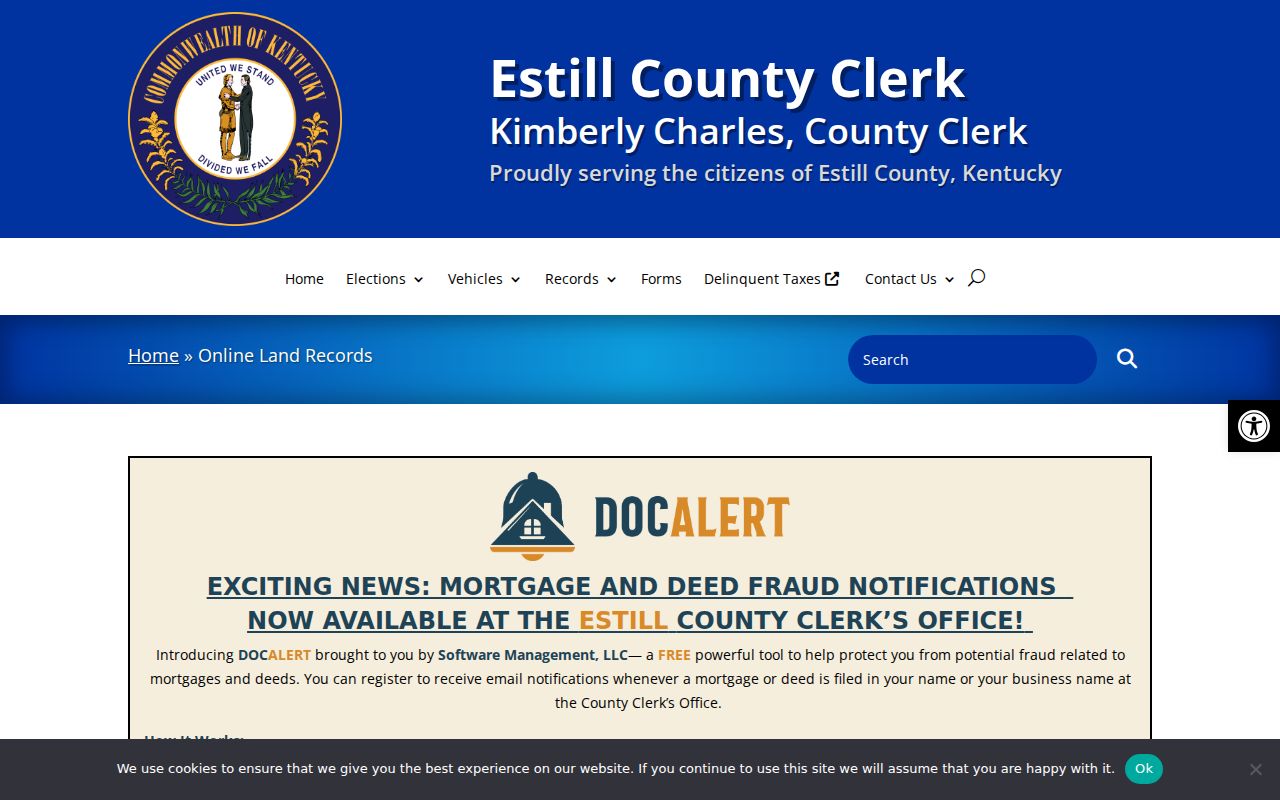
The Clerk's official page shows where a remote search starts. The office counter remains the fallback for account limits, date ranges, and missing images.
| Search input | Best use | What to retain |
|---|---|---|
| Grantor or grantee | Find a transfer by party role | Exact name, role, and date span |
| Document type | Separate deeds, mortgages, liens, and releases | Type and recording date |
| Book/page or instrument | Retrieve a known filing | Complete citation and image status |
| Subdivision or description | Distinguish similar names | Lot, block, acreage, road, or creek wording |
A free public account allows five searches per day and runs from 9 a.m. to 7 p.m. on weekdays. There is no weekend access. Paid registration exists for broader use. The indices and records stay free to inspect in the Clerk's office, so the online limits do not make the records private.
Estill Deed Images Since 2004
Indexing and imaging are not the same thing. A 1970 deed can sit inside the stated 1966 index coverage. Yet it may still need an office image, a microfilm check, or a copy request. Online, special viewing software may be required, and data or image fees may apply. Before paying, write down the party names and the date. Add the document type and the book/page or instrument number.
For a long chain of title, the courthouse counter often beats the free eCCLIX tier. Ask the Clerk to quote the current charge for an ordinary or certified copy. The Clerk publishes no complete fee sheet for copies, so assume no fixed price.
Bring the APN and any known deed citation. Include owner name variants, the subdivision, the lot or acreage, and an approximate date. Ask whether the volume is onsite, on microfilm, or held elsewhere. Note the answer and the date, since vendor access and office procedures can change.
Follow Estill's Recorded Chain
A grantor gives the stated interest; a grantee receives it. The chain of title is the linked series of recorded transfers for the same land. Start from the newest reliable deed reference and work backward. Keep the legal description beside the name at every step, because Estill's repeated surnames, farm descriptions, and town lots can produce false matches.
- Find the newest deed with the present party shown as grantee.
- Copy its grantor, recording date, deed type, and full reference.
- Search that grantor as an earlier grantee and match the same tract.
- Repeat until reaching the target year or a documented access gap.
- Grantor
- The party transferring the stated interest.
- Grantee
- The party receiving the stated interest.
- Chain of title
- The ordered sequence of recorded transfers tied to one tract.
- Book/page or instrument number
- The citation used to retrieve the recorded document.
Preserve every reference to a parent tract, prior deed, survey, plat, exception, easement, or correction. Those details can prove that two similar entries describe different land. To trace prior parties further back, the former Estill County owners route extends this process in time.
Town Lots and Farm Tracts
Estill deed records speak in several geographic vocabularies. Rural land may carry an acreage figure, metes and bounds, a road, a creek, or a ridge. It may also list a farm name or a parent tract. Irvine and Ravenna records may instead cite a subdivision, lot, and block. Search both the modern address and the older description.
Ravenna shows how this works. Ravenna Realty Company formed in 1915 to develop railroad-linked town lots. The town incorporated in 1921. Local transfer notices mention Ravenna Realty blocks, Stacy Addition, and Main Street. They also cite the 5th and Elm area. Those notices are useful index leads. Only the Clerk's instrument and plat establish the recorded land description.
Older Estill Land Books
Estill County was created in 1808 from Clark and Madison counties. A chain reaching before county formation may lead into parent-county deeds. It may also point to Kentucky land-office material, warrants, or surveys. KDLA inventories describe Estill deed material from 1808 forward. They also cover tax books, surveys, wills, and court records.
For material outside the online range, turn to the Clerk's office. The KDLA land-record inventory lists holdings in detail. The FamilySearch Catalog, the Estill County Public Library, and the Estill Historical & Genealogical Society can help too. KDLA requests may take four to six weeks. Treat a catalog or local abstract as a finding aid, not a certified deed.
The 1864 Estill Record Break
Estill County lost records in an 1864 courthouse disaster, according to KDLA accounts. The finding aids do not list every land series or page that burned. So a gap is plausible. It still does not prove your missing deed was destroyed. Treat the break as a reason to widen the search, not end it.
Rebuild the trail from what survived. Deed indexes and surveys can carry the thread. Tax books and wills can too. Court orders and parent-county records can all help. So can newspapers and local abstracts. Log each volume, year, query, and repository as you go. That discipline separates a true series gap from a simple account limit. It also rules out a spelling variation or an image that never went online.
Estill Deed Alert Limits
The Clerk offers DOC ALERT. The service watches a registered name for new deed or mortgage filings. Treat any notice as a nudge. It flags activity; it does not prove fraud or a title transfer. A deed alert is also no substitute for reviewing the recorded chain yourself. Check it on a regular basis.
Register the name exactly as earlier instruments spell it. Account for initials, maiden names, and entity variants, since a mismatch can silence the alert. When a notice arrives, verify the filing with the Clerk. Confirm the instrument number, parties, recording date, and legal description before drawing any conclusion.
The FY 2025 Clerk budget contains a records digitization line item. That shows funding exists. It says nothing about which deed books were scanned or when images go public. Ask the Clerk about the project's current scope rather than assuming new online coverage.
Request an Estill Deed Copy
Three paths lead to an Estill County deed copy. Use an online image when one exists. You can inspect the index and record free at the Clerk's office. Or send a specific written request. Whatever the route, state the essentials up front. Give party names, deed type, and date span. Add the parcel or legal description, and any known book/page or instrument number. Say whether you need a plain scan or a certified copy. Ask for a fee estimate.
Kentucky's Open Records Act, KRS 61.870 through 61.884, sets the written-request framework. KRS 61.872 covers applications, and KRS 61.874 governs inspection and reproduction costs. Under KRS 61.880, the agency must respond in writing within five business days. Weekends and legal holidays do not count. Direct the request to the actual custodian of the deed records. Do not use a broad statewide portal.
Ask for inspection first when the citation is uncertain. After the right instrument is identified, request only the pages you need and state whether certification matters. Keep the Clerk's response, fee quote, delivery format, and any explanation about an unavailable volume or image. That paper trail pays off. An index entry may exist, but the linked image can fall outside the normal online range.
Recorded is not guaranteed. The index reports filed instruments; it is not a title opinion and cannot rule out an unrecorded interest.
Log your access date and every spelling variant you tried. That short record lets the Clerk repeat the search and explain any missing deed image.