
Run an Estill Property Search
Address, owner, and parcel number are three doors into the same Estill record trail. An address starts in the Estill PVA qPublic app. Names need two sources. Query both qPublic and eCCLIX when the owner is a person or a business. Once an APN appears, treat it as the stable cross-check. Keep the address and legal description beside it.
- Enter the street name first, then add the number or road suffix if needed.
- Open the parcel and copy its APN, tax owner, value year, and deed reference.
- Search the Clerk's index under the owner as grantee and grantor.
- Compare the parcel map and ask the Sheriff for the current tax bill.
- Order the recorded deed or request an office search when proof is needed.
Estill qPublic Search Modes
The official PVA site hands parcel search and mapping to Schneider qPublic. Name, address, parcel number, and alternate ID are the usual search modes. The county's live qPublic site blocks public access. That block hides its exact local labels, wildcard rules, pagination, downloads, and tabs. They remain unconfirmed.
| Likely mode | Input to preserve | Local caution |
|---|---|---|
| Name | Surname, given name, initials, entity form | Cross-check with address and APN |
| Address | Number, street, route, suffix | Try road-name and postal-place variants |
| Parcel or alternate ID | Full printed identifier | Do not drop zeroes or decimal suffix |
Open the official Estill PVA source shown in this capture.
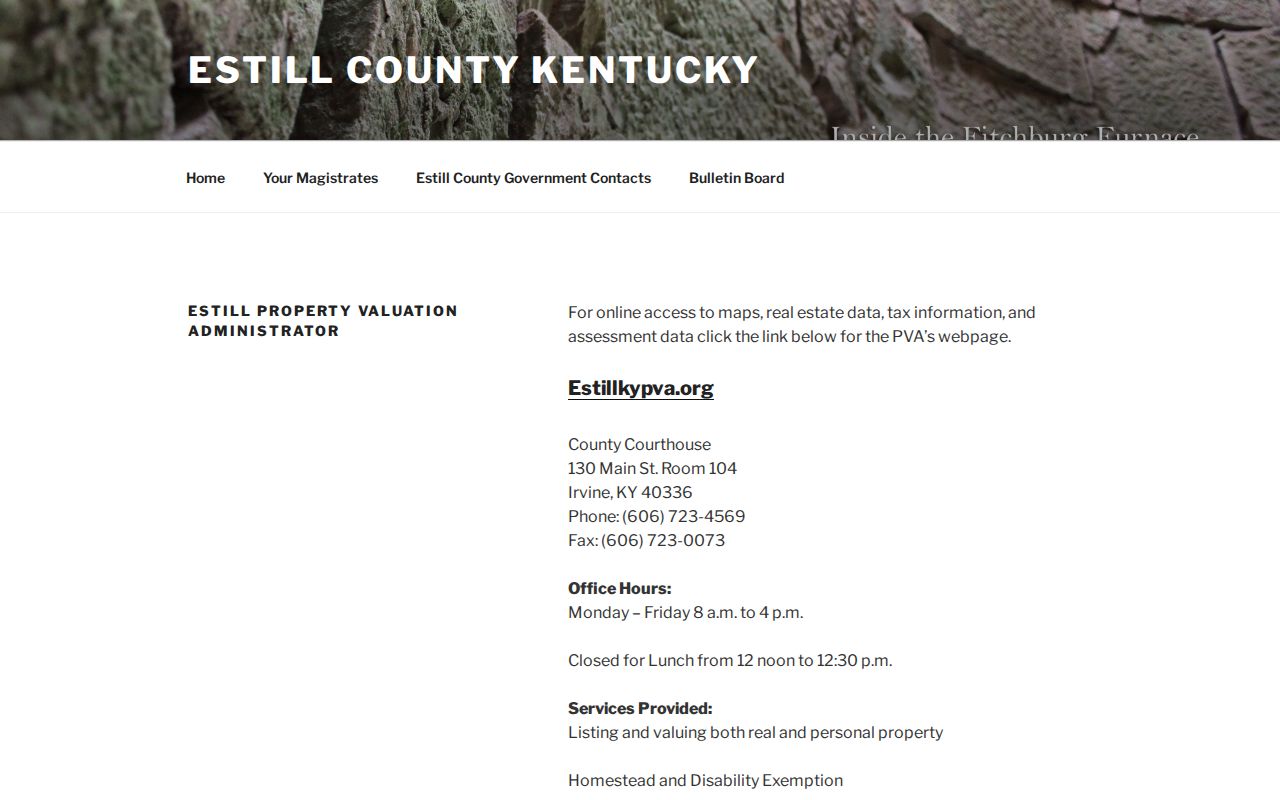
This qPublic page marks the official Estill search route.
Copy Estill APNs Exactly
Estill parcel numbers use hyphens and a decimal suffix. Official examples include 053-00-00-030.00, 053-00-00-008.00, and 053-00-00-008.01. The suffix likely separates related or split parcels, but the county publishes no coding legend. Never decode a segment past the evidence.
Enter the complete printed APN first, and if it fails, save that attempt. Test a punctuation-free form second, and keep the original query on file, because a failed format never proves the parcel or its record is missing.
- APN
- The assessor's parcel identifier.
- Situs address
- The location label for the land, not necessarily the owner's mail address.
- Owner of record
- The named owner within a particular official record and date.
- Alternate ID
- A second system key that may help locate the same parcel.
Normalize Estill Rural Addresses
Rural Estill land often hides behind a highway, route, creek, farm, tract, or community label instead of a modern street name. Drop the road suffix first. Then try directional variants and the KYTC route number. Keep the deed's older landmark wording beside your normalized address.
Mailing city and city limits are two different things in Estill County. An Irvine mailing address can sit outside Irvine. A Ravenna subdivision description may need an incorporated-boundary check. Use the PVA map, the KYTC road and boundary map, city zoning material, and the USPS lookup as separate evidence instead of forcing them into one label.
Search Estill Owner Names
An owner-name query in Estill County has to be broad enough to catch index variants yet narrow enough to avoid merging unrelated people. Test surname-first and given-name-first forms. Add initials, former names from deeds, and the exact legal name of any trust or business. Then demand two independent anchors. A shared parcel, address, or deed reference counts.
The January 1 tax-owner rule matters here too. A PVA result can still name the prior owner after a later deed is recorded. Search the latest grantee in eCCLIX, compare recording dates, and describe each source by its own date.
Move From Parcel to Deed
The Estill County Clerk's eCCLIX index is the next stop once a parcel search yields a name or a book and page. Search the owner as both grantee and grantor. Use the document-type and date filters. Note the deed type, parties, recording date, book and page, acreage or lot terms, exceptions, and any parent deed reference.
Deeds and mortgages index back to 1966. Most online images start in January 2004. A free public account allows five searches per day, weekdays only, from 9 a.m. to 7 p.m. In-office public indices are free. Older or image-only work may require the Clerk, microfilm, KDLA, or FamilySearch, and the official Estill land-record access page offers direct entry.
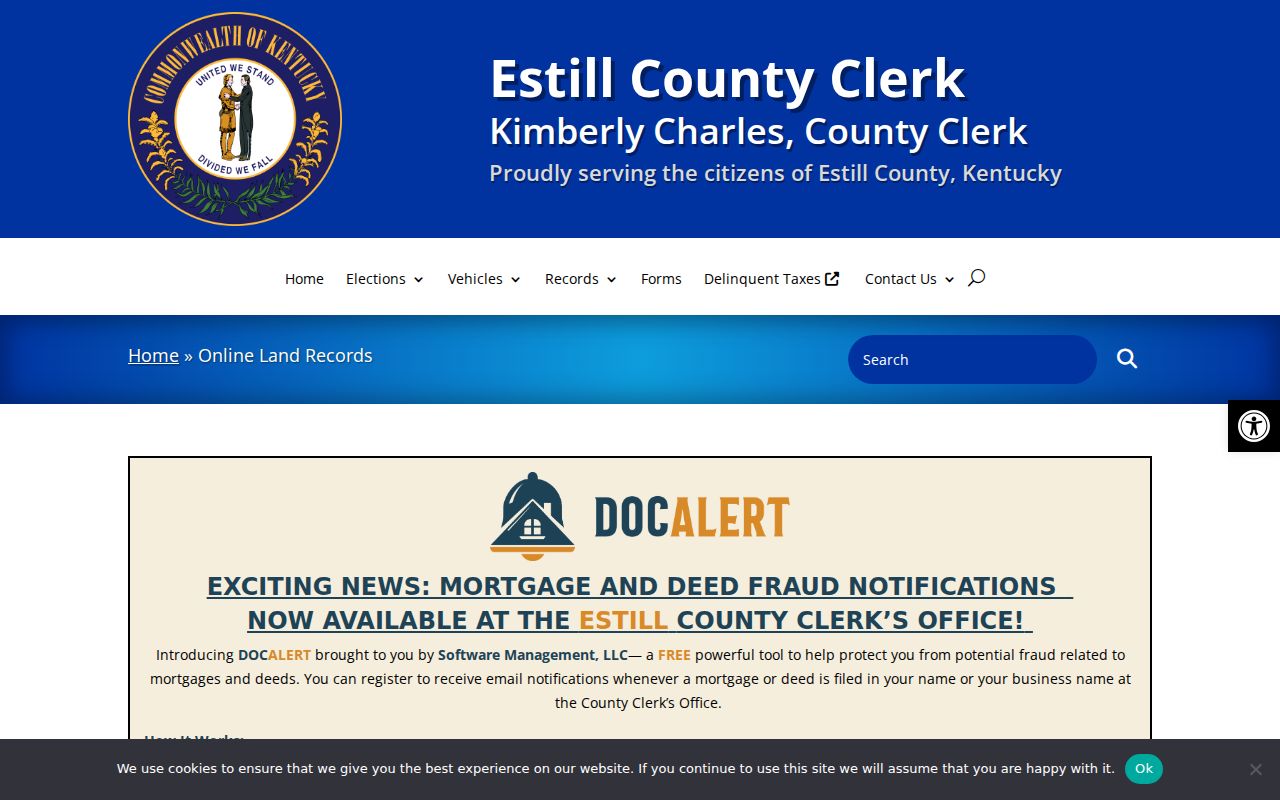
The capture documents the portal route and restrictions. It is not a deed result.
When Estill Search Returns Nothing
A blank screen means little by itself. A spelling choice, an address change, a blocked application, an account limit, a date cutoff, or a missing online image could all be the cause. State the scope you tested. Never claim no record exists. Log the exact URL, time, search mode, terms, filters, result count, and any visible warning.
Then run the fallback chain. Call or visit the PVA for parcel identification, ask the Clerk to confirm the land index, and inspect older books or microfilm. KDLA, FamilySearch, the local historical society, and Estill County Public Library can carry older descriptions and transfer leads, which makes a negative search useful only when someone else can reproduce its limits.
Fields in an Estill Result
An Estill property search result is a set of fields with different dates and meanings. Dates matter more than labels. The generic qPublic format can show a parcel number. It can also show alternate ID, address, ownership, city, area, state, assessed value, reference number, and section-township-range fields. The live Estill configuration blocks public access. Treat only fields in the official sample as local evidence.
| Tax owner | Owner used for the assessment date, which may lag a later deed |
|---|---|
| Property location | The situs or physical label, distinct from an owner's mailing address |
| Parcel number | The formatted key joining the card, map, bill, and deed reference |
| Assessment | Land, improvement, or total tax value when supplied, with its year |
| Legal description | Acreage, lot/block, subdivision, or other abbreviated land text |
| Deed reference | Book/page or instrument lead for the Clerk's record |
The official 2022 tax statement shows the APN, location, acreage, legal description, deed reference, exemption, and owner fields. It settles no 2026 status, boundary, or title.
Log an Estill Search Result
A good search log tells a true no-result apart from a portal limit. Save the exact URL, the date and time, the search mode, the terms, any filters, the number of hits, and the result you chose. Log the parcel number or book and page too. Was a login, payment, or access block involved? Say so. If an image was missing, note that as well. Keep an uncropped screenshot with the source and date, then make a smaller working copy.
A negative search needs its scope spelled out. For example, no result for that exact parcel number in the application you searched, or no image visible before the stated cutoff. Then switch to the office route. The County Clerk can confirm an index. The PVA can resolve a parcel question. The Sheriff can answer current tax bill questions.
Choose an Estill Search Key
The right search key depends on what you know and what can shift. An address is intuitive, but addresses change. A name can surface several tracts, though it demands identity checks. A complete parcel number is the most exact key in Estill County, but punctuation and a decimal suffix can decide whether it matches at all.
| Search Key | Best For | Where It Works | Watch Out |
|---|---|---|---|
| Address | One known site | PVA and map | Road variants and postal-city labels |
| Owner name | Possible parcels held by one named party | PVA and Clerk | Initials, entities, former names, same names |
| Parcel number | Exact parcel cross-check | PVA, map, bill references | Leading zeroes, hyphens, .00 or .01 suffix |
Not a title search. An Estill County property search locates public records but cannot guarantee clear title, resolve every claim, or replace a qualified title professional.
Crosswalk an Estill Address
Sometimes the road name, mailing city, and legal description refuse to agree. An address-to-parcel crosswalk helps with that. Build one row for the source address and a separate field for the normalized form. Then add the postal city and the incorporated place. Add the parcel number and the owner field. Include the deed reference, the assessment year, and the map date. Laid out that way, a mismatch becomes visible instead of silently picking one label.
Rural Estill County searches often run on route numbers. Highway names, creeks, farms, and nearby communities appear too. Try the street name without its suffix first. Then test a directional or route form. For the city label, weigh the PVA map against official boundaries. Then check zoning material, USPS data, and the KYTC map. An Irvine mailing address can sit outside the city. Annexation can shift municipal jurisdiction while an older deed description stays untouched.
When an address itself has changed, the parcel number and legal description are your anchors. Search both the old and new address forms. Chase grantor and grantee names. Follow subdivision and lot or block terms. Add the predecessor book and page. A correction deed, affidavit, plat change, annexation record, or parcel split may explain everything. Don't call the record wrong until those paths have been checked.
Separate Estill Record Dates
Every Estill County property search should attach a date to each fact. Kentucky assesses real property as of January 1. The local PVA explains that the tax owner is also fixed on that date, so a later buyer can appear on a newly recorded deed while the former owner remains on the year's bill. The office may mail the bill care of the new owner, but that mailing step does not change the assessment date.
Record the deed execution date, recording date, assessment date, bill year, map or imagery date, and the date the search was run. Those dates answer different questions. A sale after January 1 can be valid even if the assessment has not caught up. A tax map can be useful even when its aerial is older, provided the map date is stated and no one treats it as a survey.
The same discipline applies to a blank result. State that no match appeared for the exact terms on the inspected date. Note whether qPublic was blocked, eCCLIX hit an account limit, an image predated online coverage, or no current bill portal was located. Then use the PVA, Clerk, Sheriff, archive, or court fallback. A narrow negative finding is honest and reproducible; “no record exists” is not.
A subdivision or lot search opens another route when neither address nor owner works. Estill transfer notices mention names like Indian Point, Estill Acres, Beechwood Estates, Ravenna Realty, and Stacy Addition. Use those as leads in the Clerk's legal-description or subdivision search. Then read the recorded deed and its referenced plat. A news item won't supply full exceptions, easements, or proof of title.
Keep related instruments tied to the same parcel and parties. Once the deed is found, check the Clerk's categories for mortgages, assignments, releases, mechanic's liens, tax liens, powers of attorney, and correction deeds within the relevant dates. Match each release to the claim it releases. UCC filings belong to the Secretary of State. The collateral filing isn't a county real-estate instrument.
For older Estill County property search work, the online cutoff is only the first wall. Ask the Clerk for the index and book. Use microfilm where it exists. Check KDLA's land and county inventories and the FamilySearch catalog. The Estill Historical and Genealogical Society and the public library can offer local names, newspaper dates, or place clues. Those can lead back to an official book and page.