
Estill Former-Owner Timeline Sources
Every era points to a different source. For current recording, the County Clerk is the strongest office to check. KDLA and FamilySearch carry the search deeper with finding aids, microfilm, and older deed collections. Tax books and newspapers can bridge a name or a year. They step in when the record goes quiet. They support the trail, though, and never replace the recorded conveyance itself. Match the source to the era and the chain stays honest.
| Source | Years It Covers | Where Held | What It Shows |
|---|---|---|---|
| eCCLIX deed index | 1966 forward | Online and County Clerk | Party roles, dates, and recording references |
| Online instrument images | Mostly January 2004 forward | eCCLIX account | Viewable deed text when available |
| Historic deed holdings | 1808 forward in inventory | Clerk, KDLA, FamilySearch | Earlier conveyances and legal descriptions |
| Tax, survey, will, and court series | Varies by collection | KDLA, local sources, court | Continuity clues around a missing link |
Start with the newest deed no matter which era you seek. When the free eCCLIX account hits a limit or an image cutoff, move to the public counter. Only after recording the exact gap should an archive inventory enter the plan.
Estill's Index and Image Cutoffs
The Estill County Clerk indexes and scans deeds and mortgages back to 1966. Separately, the same office notes that most online instrument images start in January 2004. Those are two different promises, and the difference matters. An index result from 1980 can still name a prior owner and a book/page citation even when the deed image itself is unavailable from home.
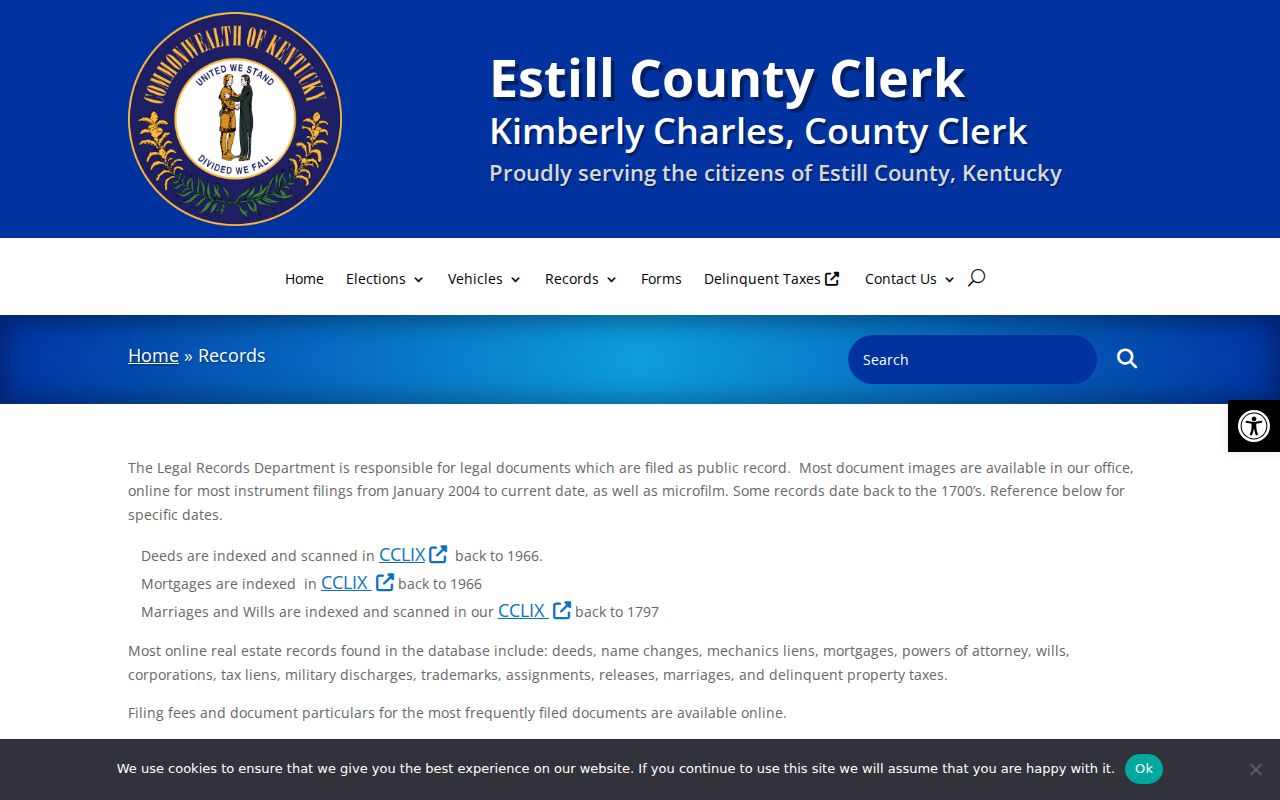
The Clerk's own records page displays both coverage milestones. It also directs older ownership questions back to its holdings.
The free eCCLIX account runs weekdays from 9 a.m. to 7 p.m. It allows five searches per day. A long ownership history can burn through that allowance fast. Indices and records are free to inspect at the Clerk's office. Paid online access is offered as well. Ask about current image or copy fees instead of guessing.
Reconstruct Estill Owners Backward
A reverse search walks the land from its newest conveyance toward earlier owners. The grantor transfers the interest. The grantee receives it. The chain of title is simply those recorded links lined up in order.
- Find the latest deed and confirm its parcel or full legal description.
- Copy the grantor, grantee, deed type, date, and complete citation.
- Search that grantor as an earlier grantee within a sensible date range.
- Match the tract, record the prior link, and repeat to the target year.
- Grantor and grantee
- The transferor and recipient named in the instrument.
- Reverse index
- An index organized to find earlier acquisitions through party roles.
- Chain of title
- The recorded succession of interests in the same land.
- Legal description
- The land wording that survives when an address changes.
Expect messiness. Correction deeds, quitclaims, releases, assignments, powers of attorney, and fiduciary or commissioner deeds all interrupt a tidy surname line. Estates, trusts, court sales, and parcel splits break it further.
Keep a timeline with one row per conveyance: recording date, grantor to grantee, deed type, full citation, and a short description match. Note the repository too. Laid out this way, overlaps, partial-interest transfers, missing years, and repeat players in multiple roles all surface quickly.
Estill Town Lots and Tracts
Match former owners to land, not to a surname alone. Rural instruments lean on acreage, farm names, roads, creeks, calls, or a parent tract. Town deeds usually cite subdivision, lot, and block instead. Keep every prior-deed, plat, exception, survey, and easement reference you meet.
Ravenna's past supplies useful search strings. The Ravenna Realty Company formed in 1915 to develop railroad-linked town lots. The city incorporated later, in 1921. Recorded-transfer reports mention Ravenna Realty blocks, Stacy Addition, Main Street, and the 5th and Elm area. A newspaper notice can point you toward an index entry. But it never proves the transfer.
Estill History Begins in 1808
Estill County was formed from Clark and Madison counties in 1808. Prior owners from before that year may live in parent-county books. They may also appear in Kentucky land-office material, warrants, surveys, or early deeds. A tract recorded under an older jurisdiction should not be forced into the modern county's name.
KDLA's land inventory describes Estill deed records from 1808 forward. It also lists tax books, surveys, wills, and warrants. The FamilySearch Catalog can pinpoint films or digital collections. The Estill Historical & Genealogical Society holds family files, microfilm, and published abstracts. The local library supports newspaper and history research. Treat these as lead generators, and verify each one against original records.
The 1864 Estill Courthouse Gap
KDLA records an Estill courthouse disaster in 1864. It does not list every land book, index, or page affected. A missing result near that date is a documented gap. It is not proof the deed was destroyed.
Work the parallel evidence instead: surviving deeds, surveys, tax books, wills, court orders, parent-county material, newspapers, and local abstracts. A tax book can show a name and acreage persisting, but it is not title. A will may explain an heir. Yet the later deed or court order often defines how the parcel actually passed.
Estill Library Ownership Clues
The Estill County Public Library sits at 184 Broadway in Irvine. It offers a local research stop with public computers. Newspaper support is available there too. One library service provides NewsBank material carrying real-estate notices and government information. HeritageHub adds obituary and death-notice content reaching back to 1824.
The Library of Congress catalog lists scattered Estill Herald microfilm from 1927 through 1968. It also notes a service copy at the local library. Ask which exact issue dates are on hand. An obituary or transfer notice can explain a surname change. It may point to an estate or an approximate date. The deed, will, or court order still carries the greater weight.
Estill Probate and Court Links
A prior owner does not always pass title through an ordinary sale. Sometimes a will, fiduciary deed, foreclosure, or partition explains the change. So can a sheriff sale, commissioner deed, or court judgment. Litigation or probate may sit behind a transition. Start with the Estill Circuit Court Clerk. Then pull the recorded instrument from the County Clerk to close the loop.
Keep the case number, party roles, disposition, sale confirmation, and recording reference. Online KYeCourts information is not the official court record. A newspaper notice or docket entry is only a lead, so treat it that way. Wait until the recorded deed itself supports the claim that ownership changed.
Document an Estill Chain Gap
A solid gap note lists the repository, the exact query, name variants, document type, date span, legal description, APN, and coverage statement. It also records the access date. Each detail matters. Say "not located in official sources" only when that is literally what happened. A blocked portal, an exhausted free-account limit, an unavailable image, or an incomplete microfilm run is a different situation. It deserves a different label.
Need a single deed copy instead? The Estill County deed-record route walks through index and copy access. Former-owner work stays focused on the backward succession of owners. Document clearly the point where that succession can no longer be proven.
How Deep Estill Ownership Goes
Estill ownership records have an official 1808 starting context. Later came a 1966 Clerk index milestone, and most online images begin around January 2004. None of that promises every link is complete or visible online. Older research can branch widely. Original books, microfilm, and archive requests are common next steps. Parent counties, surveys, warrants, tax lists, wills, court orders, and plats also matter.
Stop only at a defined target date or a well-documented gap. Never fill a break with an assumption. Occupancy, a tax name, an obituary, or a nearby parcel will not settle it. For legal reliance, get certified instruments and qualified title help.
A modern APN can change too. Splits, consolidations, corrections, and mapping updates all create new numbers. Keep predecessor and successor numbers whenever a card or survey supplies them. Follow the legal description, the parent-deed citation, acreage changes, and plats. Do not treat a fresh suffix as the start of the ownership story.
Use records responsibly. Research former owners for title, estate, boundary, or house-history work, never to stalk, harass, or target a living person.